

Bhagavan's Attendant Venkatarathnam
Part II

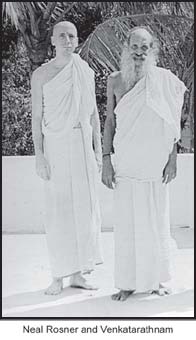
Sri Venkatarathnam lived with Bhagavan from 1944 to 1950. During the last year he served as one of his personal attendants. Neal Rosner came to Sri Ramanasramam from the USA in 1968, attached himself to Venkatarathnam and diligently served him until his passing in 1976. Nealís immersion into the spiritual heritage of India under the guidance of Venkatarathnam is elaborately described in his book On the Road to Freedom: A Pilgrimage in India. He now resides at Amritanandamayi Ma's Kerala Ashram and is known as Swami Paramatmananda. In the following article, details regarding the life of Venkatarathnam have been extracted from a 25-page essay written about Venkatarathnam by Neal Rosner. He presented this manuscript to us thirty years ago at Sri Ramanasramam.
Wanderings and Company of Saints
DURING the subsequent ten years after Bhagavan's Mahasamadhi, Venkatarathnam spent his time going on pilgrimage, meeting with devotees, mahatmas and saints, but always returning to Arunachalam and Bhagavan's ashram. In 1956 Sri Venkatarathnam went to Kerala on foot and took a vow not to ask anyone for food or water and to only accept whatever was given unasked. He also chose not disclose his identity as a disciple of the Maharshi to anyone during his travels in Kerala, and he did not carry money with him. He spent about six months like this, depending entirely on God, in order to test how deep his surrender actually was.
Back in Sri Ramanasramam
In 1967 the Mahakumbabhishekam of Sri Ramana Maharshiís Samadhi was performed and Venkatarathnam was then requested to serve in the Ashram. He continued this service until September 1969.
I first met Venkatarathnam [writes Neal Rosner] in September 1968. Venkatarathnam was returning to his room after completing the seva at Sri Ramana's Samadhi. When I saw his face which was glowing with tejas and ananda a shock went through my being and I wondered who he might be. The next night I met him on the Hill where he was talking to some devotees about Divine Consciousness. Someone asked, "What is the flash of Divine Consciousness?" He replied that it is like a flash of lightning which illumines everything for a moment and then everything is dark again. Just then there was a brilliant flash of lightning, as if to demonstrate what he has just said.
Routine in the Ashram
At this time Sri Venkatarathnam was very busy with his daily routine which was roughly as follows: 3:30 a.m. got up, swept the room, went to the latrine, etc.; 4:30 a.m., finished bath, sandhya (puja), japa and cleaned his altar; 5:15, went to Bhagavan's Samadhi, cleaned and swept it, and then arranged for the 6:15 puja. From 7 to 8:15 he performed his own Panchyatana puja, 8:15 to 9:15 he did Samadhi puja and from 9:30 to 11:30 did japa and studied the Srimad Bagavatam. Then he partook of food. From 12 to 2 p.m. he rested or spent the time in visiting and meeting devotees. 2 to 4 p.m., he wrote letters, etc; 4 p.m. bath; 4:30 to 6:30, Samadhi Shrine work, Veda Parayana and puja; 6:30 to 7 p.m., sandhya and japa; 7:30 was mealtime; and 8 to 11 p.m., miscellaneous activities or satsang; 11 p.m. sleep.
It was at this time that I started assisting him in work, like picking flowers for puja, sweeping or any other service he might give me to do. While near Bhagavan's Samadhi he would not speak to anyone unless it was regarding the immediate work at hand. He often said, "The Samadhi is the same as Sri Bhagavan. As I felt near his body during his lifetime, I feel the same near his Samadhi now. It is Him only."
Frequently he would go on Giripradakshina during the nights after 8:30, usually returning only the next morning, and then again start the daily routine without even resting.
I asked him how could bear the strain day after day. He simply said that when there is love of God one doesnít feel any strain however great it may be. It is only when the love and interest go away that boredom and strain are felt. If any new bhaktas would come to visit from outside he always made it a point to go and meet them and spend time with them, more so if they had real devotion and sincerity. He spent many sleepless nights like this in satsang.
In 1967, on May 14th he met with H. H. Sri Chandrashekharendra Saraswati Swamiji, Jagadguru Sankaracharya of Kanchi Kamakoti Peetham, for the third time and received from him mantra diksha of Siva Panchakshari mantra. He also received a Hayagriva Salagram from His Holiness. After this he used to daily repeat 2,000 - 3,000 Gayatri mantras and 5,000 - 10,000 Panchakshari mantras. By the middle of 1969 he had done 14 lakhs [1.4 million] of the Panchakshari mantra. In August 1969, he decided to somehow complete the minimum number of japa as recommended by His Holiness and proceed to Hyderabad to perform the yearly sraddha of his parents. To do this he had to sit for japa eight hours a day and after finally finishing it he had a physical breakdown. After some days bedridden, he left for Hyderabad in October 1969.
Hospitalization
When I came to Hyderabad to meet him, I found him in Osmania General Hospital with a fractured right hip. Riding as a passenger on a scooter he was struck by a taxi. When I asked him how he had such an accident he said, "What accident? Is birth an accident? Is there any such thing as an accident for a bhakta? It is the sweet will of the Lord, that is all."
The area around his hospital bed literally became an ashram, with photos of Sri Ramana and Arunachala, observance of occasional festivals like Ramana Jayanti and Karthik Deepotsavam. There seemed to be a continuous stream of devotees from 9:00 a.m. till midnight, or later. Usually in the nights I expected that I could get some rest, but at that hour the attending physician, who was a bhakta, used to come and enjoy the satsang till midnight or 1.00 a.m.
At this time, his revered friend Avadhutendra Saraswati Swamiji, came to Hyderabad to see him, and visited him every day for some time. Sri Gangeswarananda Swami, a great blind Vedic scholar, also came to the hospital and Sri Venkatarathnam did pada puja to him from the bed itself and then presented him with new clothes, etc. A number of other saints also came. At the time of going into the operation room, Sri Venkatarathnam suddenly experienced such a high state of Divine ecstacy that he felt that the operation could be done without the usual anaesthesia, as he was feeling completely devoid of identification with the body. Most of the people present mistook this ecstacy for either fear or insanity, but the real bhaktas recognized it as a very high state. After returning from the operation, the area around his bed was serene with the peace of Brahman radiating all round while bhajans went on for a long time. Afterwards Venkatarathnam used to say to the more worldly devotees, "See, you people say that I am a sadhu and that if I fall sick, who will look after me since everyone is so busy with his own family affairs and has no time to attend to a sick sadhu. Well, who sent this Nealu [the name he called Neal Rosner] here? I did not write to him or call him to come here. God has sent him here to look after me. It is said that God Himself takes on the responsibility to look after those devotees who depend entirely on Him. Now you can see the truth of it."
After four months he was discharged from the hospital and stayed at Malakpet with Sri V. Srinivasan, who was the Inspector General of Prisons at that time. He and his wife treated Sri Venakatarathnam with the fullest hospitality and affection for more than two months. For the rest of his life he was grateful to them for the love and concern which they had showered on him at that time. This was May 1970.
Pilgrimage to the Himalayas
From Hyderabad we traveled north with Swami Avadhutendra Saraswati and eventually reached Nepal in August 1970. After Swamiji left us in Kathmandu, we flew to Pokhara and from there walked seventy miles into the Himalayas to Muktinath, the Abode of Muktinarayana. This place is sometimes called Salagrama Kshetra and is the 107th Dham on earth, Vaikuntha being the 108th. This walk was extremely difficult. We often got lost in the forests and were caught in darkness before we could reach the next village. Because I was a foreigner and lacked security clearance, government officials made me stop about ten miles before reaching Muktinath, a politically sensitive area at the time. Venkatarathnam and his sister proceeded alone. The way was very dangerous and windy and they even turned back once or twice thinking that they would get blown into the rushing river far below.
One night before reaching Muktinath, Sri Venkatarathnam suddenly got up and was loudly repeating Vishnu Sahasranam at about 1 a.m. In the morning he told me that he had a vision of people with water pots on their heads, going from a river to a temple which had a big Chakra in front of it. He had woke to the loud sound "Narayana, Narayana" ringing in his ears, as if someone were shouting it in the room. It was then that he started doing the Vishnu Sahasranam. He said that usually when he gets within a certain distance of the destination, he will have a dream about the deity of that place and the name Siva or Narayana will be ringing in his ears. When they finally reached Muktinath, sure enough there was a big chakra in front of the temple as he had seen in the vision.
Proceeding to Durgapur, we accompanied his sister, her husband and daughter to Gaya, Kashi, and Prayaga, doing sraddha and puja in all the places. This took about three weeks. When we reached Jhunsi we unexpectedly found Swamiji there, and spent about two weeks at Brahmachariji's ashram. From that time till mid 1972 we were either at Arunachalam or travelling with Swamiji to various bhajans and Saptahas [day and night bhajan programs]
Muruganar
In August 1973, Sri Muruganar, one of the intimate sishyas of the Maharshi, attained Siddhi in the Ashram. Venkatarathnam personally performed the 40-day puja at his samadhi and also the Mandalabhishekam. During all this time he suffered from chest pain and weakness but nevertheless finished his duty to a brother bhakta.
There Is One Thing More
"A Realized Soul who knows the truth is aware of the fact that he is not the body. But there is one thing more. Unless one looks upon death as a thing that is very near and might happen at any moment, one will not be aware of the Self. This means that the ego must die, must vanish, along with the inherent vasanas."
Follow One of Three Paths
D.: How is restlessness removed from the mind?
M.: External contacts - contacts with objects other than itself - make the mind restless. Loss of interest in non-Self, (vairagya) is the first step. Then the habits of introspection and concentration follow. They are characterised by control of external senses, internal faculties, etc. (sama, dama, etc.) ending in samadhi (undistracted mind).
D.: How are they practised?
M.: An examination of the ephemeral nature of external phenomena leads to vairagya. Hence enquiry (vichara) is the first and foremost step to be taken. When vichara continues automatically, it results in a contempt for wealth, fame, ease, pleasure, etc. The 'I' thought becomes clearer for inspection. The source of 'I' is the Heart - the final goal.
If, however, the aspirant is not temperamentally suited to Vichara Marga (to the introspective analytical method), he must develop bhakti (devotion) to an ideal – may be God, Guru, humanity in general, ethical laws, or even the idea of beauty. When one of these takes possession of the individual, other attachments grow weaker, i.e., dispassion (vairagya) develops. Attachment for the ideal simultaneously grows and finally holds the field. Thus ekagrata (concentration) grows simultaneously and imperceptibly – with or without visions and direct aids.
In the absence of enquiry and devotion, the natural sedative pranayama (breath regulation) may be tried. This is known as Yoga Marga. If life is imperilled the whole interest centres round the one point, the saving of life. If the breath is held the mind cannot afford to (and does not) jump at its pets – external objects. Thus there is rest for the mind so long as the breath is held. All attention being turned on breath or its regulation, other interests are lost. Again, passions are attended with irregular breathing, whereas calm and happiness are attended with slow and regular breathing. Paroxysm of joy is in fact as painful as one of pain, and both are accompanied by ruffled breaths. Real peace is happiness. Pleasures do not form happiness.
The mind improves by practice and becomes finer just as the razor's edge is sharpened by stropping. The mind is then better able to tackle internal or external problems. If an aspirant be unsuited temperamentally for the first two methods and circumstantially (on account of age) for the third method, he must try the Karma Marga (doing good deeds, for example, social service). His nobler instincts become more evident and he derives impersonal pleasure. His smaller self is less assertive and has a chance of expanding its good side. The man becomes duly equipped for one of the three aforesaid paths. His intuition may also develop directly by this single method.
Strength of Mind, Will Power and Concentration
D.: Is it not said in the book Truth Revealed (>Ulladu Narpadu) that the world is a product of the mind?
M.: Yes.
D.: Does it not follow that the mind grown strong brings the world under control?
M.: The mind in its external activities gives rise to the world. Such activities fritter away the strength of the mind. Its strength lies in being confined to itself with the external activities arrested.
D.: There is an idiot who cannot count up to ten. His mind does not certainly wander as does that of a thinker. Is the former a better man than the latter?
M.: Who says that he is an idiot? Your mind in its wandering says so.
D.: Is will power gained by divesting oneself of thoughts?
M.: Rather by confining oneself to a single thought. Ultimately this will also disappear, leaving Pure Consciousness behind. Concentration helps one to it.
D.: So then, it is gained by directing the mind and concentrating it. The personality has nothing to do with it.
M.: Personality is the root-cause of external activities. It must sink for gaining the highest good.
Uniqueness of Sri Bhagavan
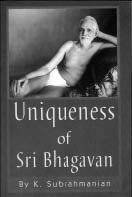
K.Subrahmanian establishes the uniqueness of Sri Bhagavan and his teachings in a beautiful, simple and effective style, under chapter titles, such as 'Silence', 'Self-enquiry', 'Freedom', 'Sadguru', 'Tension-free Life', 'Meditation', 'Happiness', 'Surrender', 'Grace', 'Compassion', 'Suffering', 'Motiveless Bhakti', 'Flood of Love' and 'Sadhana'.
All the chapters of this book have direct relevance for the practical application of Sri Ramana Maharshi's teachings in today's busy world. These writings are the fruit of a lifetime of association with and dedication to Bhagavan Ramana.
Price: $5.00 Postage: USA $2.00 / Canada $3.00
Chapter 14
Suffering
WHENEVER Sri Bhagavan was asked about the problem of suffering, he suggested a method to eliminate it. Most others trim the branches. Sri Bhagavan tackled the root of the problem. He said that whatever be the gravity of the suffering, we are not aware of it in deep sleep. When we have a terrible toothache, we can't think of anything except the pain. But the pain is not felt in deep sleep. In deep sleep, we are not conscious of the body and hence there is no pain. When the mind merges in the Self, there is no body-consciousness and therefore there is no pain. Sri Bhagavan says: 'Physical pain only follows body-consciousness. It cannot be in the absence of body-consciousness and pleasures. Pains are dependent on the ego; they cannot be without the 'I' but the 'I' can remain without them..
Even ordinarily, we notice that our pain is related to the attitude of our mind. When we have some acute pain, and a person we like walks in, our pain is relieved to some extent. When a person we dislike walks in, our pain becomes worse. In other words, our pain increases or decreases according to the state of our mind at a particular moment. Sri Bhagavan asks us to remove the mind altogether so that we won't feel the pain at all. He says: 'Therefore turn inwards and seek the Self and there will be an end both of the world and its miseries.. When body-consciousness goes, suffering goes. Prayer is good in that it makes us lose ourselves in the contemplation of the Supreme Being. When the mind is lost in contemplation, there is considerable reduction in pain. But prayer will not remove suffering totally. The individual will feel the suffering when his mind is not at prayer. Puja, japa, and prayer are all good in that they take our mind off our suffering for a while.
While they are all good as a temporary measure, removal of suffering is possible only through elimination of body-consciousness. Sri Bhagavan says: 'If one remains free from pain thus, there won't be any pain anywhere. The trouble now is due to your seeing the world outside yourself and thinking there is pain in it. But both the world and the pain are within you; if you turn inward, there will be no pain.'
To the charge that those who eliminate suffering thus are selfish and do not worry about others, Sri Bhagavan says: 'The world is not external to you. Because you wrongly identify yourself with the body, you see the world outside you and its suffering becomes apparent to you; but the world and its sufferings are not real. Seek the reality and get rid of this unreal feeling.' The understanding of oneself is the ending of suffering. The question of selfishness doesn't arise as in that state, only the Self will be seen in everybody and everything. But Sri Bhagavan doesn't say we should be indifferent to the sufferings of others. So long as we have body-consciousness, we shall be conscious of our sufferings and those of others and would be interested in removing them. Compassion is really 'your pain in my heart'. When we remove the sufferings of others, we become less 'me'-centered. But in this way, we cannot remove all the pain in the world. As pain is dependent on the ego, Sri Bhagavan suggests the removal of the ego; pain will also disappear.
This is not just theory. Sri Bhagavan exemplified what he said. When he had cancer, he behaved as if it belonged to another. He was as serene as ever and gave darshan to all till the very end. There wasn't a trace of pain on his face. His detachment from the body was total.
Interviews
The following is a transcribed video interview of Ramanachalam, taped at Sri Ramanasramam.
My father was M.S.Venkataraman of Madurai, who was a few years younger to Bhagavan. He and Bhagavan lived in the same house which was situated close to the Vaigai River. He would join Venkataraman and his friends in their nocturnal escapades. After sneaking out in the dead of the night the boys would go to river bank and practice 'chilambam' (a martial art using long bamboo poles). Once when my father returned my grandfather caught him, tied him to a tree in front of the house and caned him. Venkataraman was watching. Later when my father heard about the young Brahmana Swami dwelling in Virupaksha Cave at Arunachala he paid a visit to him out of curiosity. But the moment he stepped into Bhagavan's presence he began to shed copious tears. To his amazement he found that there was nothing there of the former Venkataraman, his playmate. When he was about to leave, Brahmana Swami asked him in subdued tone, "Is that tree still there in front of your house?"
From then on my father who was then working in the District Board Office used to rush to Tiruvannamalai whenever he felt like visiting Bhagavan. At times, he would be accompanied by my mother. At Skandashram, Mother Alagammal, who was very fond of my mother, taught her many songs of Avudayakka, pregnant with deep spiritual meaning. Later when my mother sang the song in front of Bhagavan, Bhagavan would remark, "Oh! Did mother teach you all these songs?"
I remember visiting the Ashram when I was just five. I had a high fever and was sleeping near the door of Bhagavan's hall. I felt delirious. Bhagavan would now and then lift his head from his sofa and tell me to go to sleep. I thought Bhagavan never slept.
On one occasion while leaving Bhagavan a deep sorrow suddenly over took me and I began to cry. I refused to go with my mother, telling her that I wanted to stay with Bhagavan always. Bhagavan who was going that way stopped and told me gently, "Go with your mother now and come back when you are 21 years old."
My father died in 1939 when I was just 17. After few months my mother took us for Bhagavan's darshan. When she prostrated she began to shed tears. As it was the custom in those days, my mother was not wearing any jewelry, she had her head shaved and covered it with her sari. She was wondering whether Bhagavan would recognize her in this attire. She asked, "Bhagavan do you recognize me?" He smiled and said, "Why not? Only the makeup has changed (veshamdhan maari irukku)."
When I was twenty-one I got posted as a clerk with the Inspector of Schools at Polur. As Bhagavan predicted I could now go to Tiruvannamalai on Sundays and holidays and sit at his feet. Once I took his permission to go to the summit of the hill. When I reached the summit I scraped some Kartikai Deepam residue soot from a rock and put it in a leaf. I wanted to present it to Bhagavan. When I came down Chinnaswami called and shouted, "Where were you? Bhagavan is waiting for you? Go and join him for the lunch?"
After lunch, I approached him when the attendant Krishnaswami was not there, for he would never allow anyone to approach Bhagavan easily. I took out the Deepam ghee which I had collected from the summit and offered it him. He pulled my hand closer to him and took the offered prasad and with great reverence, applied it on his forehead and asked me, "Are you satisfied now?"
At times my mother used to help Bhagavan in the kitchen. One day she was helping him in grinding. While turning the grinding stone Bhagavan's head butted against my mother's head. Immediately Bhagavan rubbed his head and exclaimed, "Ah! Parvatham, it is paining?"
While at Polur I used to read religious books. Once I read a book which explained Dakshinamurti's chinmudra. Wonder of wonders, when I entered Bhagavan's hall on the weekend he was explaining chinmudra. The purport of his talk was: "It is just like when you point to God above with your index finger. We then generally point to ourselves using our thumb. Joining of the index finger and thumb is chinmudra, which symbolically says 'That thou art (Tatvamasi)', the union of Jivatma and Paramatma."
My two younger brothers came once from Madurai with my mother. Bhagavan asked me where they were living. I replied that we were living in the lane adjacent to the Central Theatre. Bhagavan could not remember it, so I named the lane and immediately Bhagavan said, "Oh! In that dirty lane." Bhagavan used a colloquial term by which that lane was known.
I got married in 1949 and came with my wife to the Ashram in March 1950. Bhagavan was in that small room which we now call the Nirvana Room. Chinnaswami kindly permitted me and my wife to have darshan of Bhagavan in that room. As soon as I prostrated Bhagavan talked to my wife in Malayalam. How he knew that she is from Kerala is still a wonder to me.
An Invitation
December 2007 Programs at Arunachala Ashrama
in New York City
You, your family and friends are cordially invited to join us in celebrating
Mahanyasa Purvaka Rudrabhishekam
during Karthika Masa
Led by Vishnubhatla Murthy on Sunday, 2 December
10:00 am – 11:00 am
11:00 am – 2:30 pm
Upanishad Parayanam
Mahanyasa Parayanam
Rudrabhishekam with Ekadasha Rudra Parayanam
Gita Parayanam
Led by Vishnubhatla Murthy
on Sunday, 16 December
10:00 am 12:30 pm
12:30 pm 1:00 pm
Rudram and Purusha Suktam
Bhagavad Gita Parayanam
Arathi and Mantrapuspam
Sri Ramana Jayanti
The 128th Birth Anniversary of
Sri Ramana Maharshi
Saturday, 29 December
talks and puja, followed by luncheon prasadam.
(718) 560-3196 or 575-3215
Arunachala Ashrama, 86-06 Edgerton Boulevard
Jamaica Estates, NY 11374-2937
Ramana Satsangs
Satsangs with recitations, songs, readings and meditation have been going on in a few places near or in large cities. Some of them are weekly. If you would like to attend any of these, please see the Sri Ramana Satsang online pages. channel.